
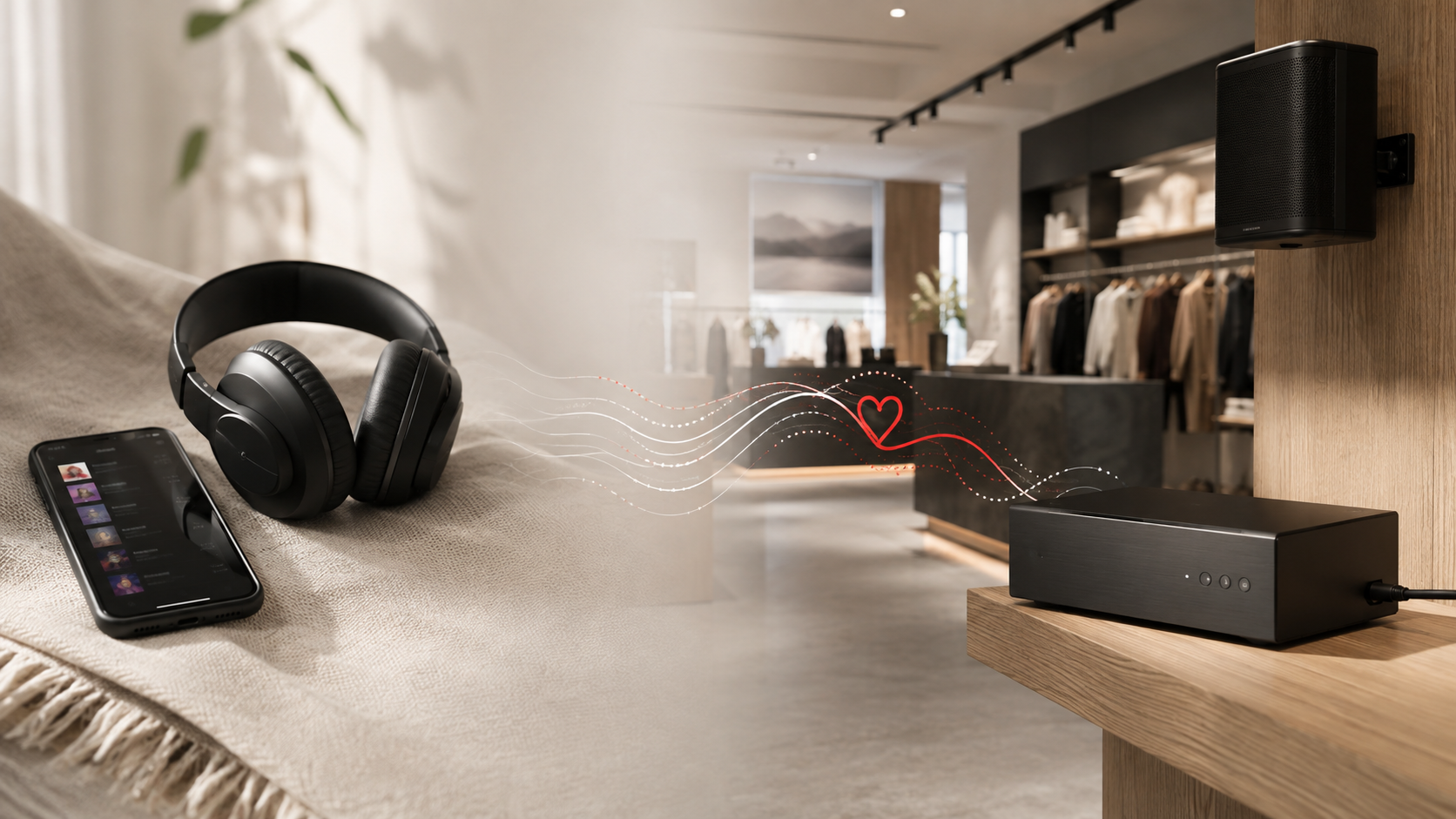
Spotify has transformed the way people discover and enjoy music. It is convenient, familiar and gives listeners access to an enormous catalogue.
However, a personal streaming account is not designed to supply music to a shop, café, salon or other commercial environment.
Spotify states that its service is for personal, non-commercial use and cannot be played publicly from businesses such as stores, restaurants and salons. The same basic restriction applies to consumer services such as YouTube and YouTube Music.
This means that paying for a personal Spotify Premium subscription does not, by itself, give a business permission to use Spotify as its in-store music supplier.
Music licensing and music supply are different
This area can understandably be confusing because there is more than one permission involved.
When music is played in a New Zealand business, it is generally considered a public performance. The copyright owners are entitled to authorise that use, either directly or through a licensing organisation.
A public-performance licence addresses the rights associated with playing the music in public. It does not necessarily change the terms of the consumer streaming platform being used to deliver it.
In practical terms, a business may need both:
- appropriate permission to play the music publicly; and
- a music supply service authorised for commercial use.
Having a OneMusic licence does not convert a personal Spotify account into a commercial music supply service. Likewise, paying for Spotify Premium does not replace the need to address the relevant public-performance rights.
The reporting gap
There is another important issue.
When an employee plays a personal Spotify or YouTube playlist in a store, the business may have no reliable record of what was played, when it was played or which licensing arrangement covered each track.
That creates a gap between the music heard by customers and the royalties paid by the business.
The streaming service may know that a track was streamed through an individual account, but that does not provide the business, HMG or its directly represented artists with the location-level reporting needed to connect that in-store use with the business’s music licence.
As a result, the business cannot easily demonstrate:
- which artists were played in each location;
- how much of its rotation was directly licensed;
- whether its approved music policy was followed;
- which licence applied to each track; or
- how its direct licence payments should be allocated between participating creators.
A music system built for business
Fair Play Aotearoa is designed specifically for commercial music use.
HMG supplies a dedicated in-store media player and manages the approved music programming remotely. The system records what was played, where it was played and the licensing category associated with each track.
This allows businesses to move away from personal streaming accounts and toward a controlled, professionally managed music environment.
It also allows HMG to increase the rotation of participating New Zealand music and create a clearer royalty pathway. When directly licensed HMG repertoire is played, we can identify the recording, measure its use and use that information when accounting to the artists and rights holders we represent.
For music outside HMG’s directly represented repertoire, we can help businesses understand the additional permissions and licensing arrangements that may still be required.
We can help businesses make the transition
Many businesses using Spotify or YouTube in-store are not trying to do the wrong thing. They are often using the tools available to them without realising that a personal streaming account and a commercial background music service are not the same thing.
HMG’s role is to make the transition practical.
If your business currently uses Spotify or YouTube, HMG can help you move toward a compliant, professionally managed solution while increasing your support for New Zealand creators.
The objective is not simply to replace one music player with another. It is to give businesses greater control and visibility while creating a more direct connection between the music being played and the people who made it.
Spotify’s guidance on commercial use is available here. Further information about the public use of copyright works in New Zealand is available through IPONZ.